HPAC P1 & P2 Ratings Course
The paragliding P1 & P2 training curriculum at Summit Paragliding is the most comprehensive in the country and will give you all the confidence you need to take flight towards new adventures. We are fully commited to making you a great pilot from the start, and offer an all inclusive course giving you all the necessary tools that will take you exactly where you want to be: flying on your own.

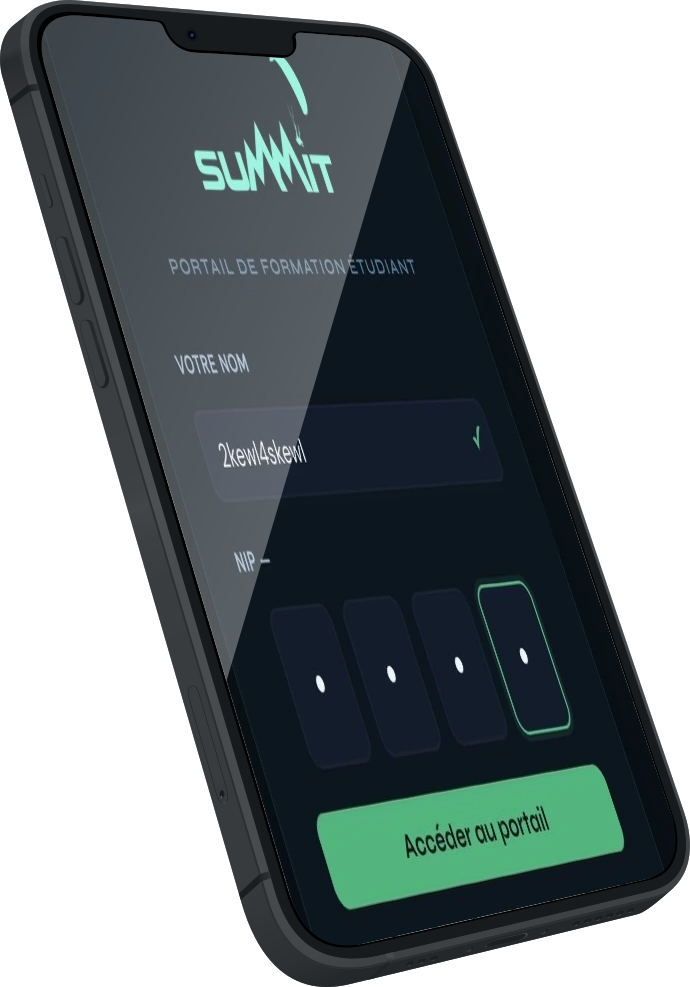
With the arrival of the Summit Paragliding app, learning becomes more immersive.
The app brings together everything a student needs in one place:
personalized pilot profile,
progress chart,
theoretical content and course materials,
flight log with GPS tracking and live monitoring,
instructor feedback,
goals and achievements,
weather references and training tools,
and much more.
Developed in-house, designed for Summit students. The future of paragliding training.
HPAC P1: Content
General description
P1 The Beginner Pilot has the basic knowledge and techniques necessary for flying and practices under the direct supervision of an
instructor and within significant operational limitations. The pilot understands the paragliding qualification system
ACVL/HPAC and the recommended operational limitations.
1. Practical skills
a. Ground handling
b. Training flights
c. Flight skills – see "Demonstrated Skills & Recorded Requirements"
2. Theoretical knowledge
a. Basic aerodynamics
b. Basic meteorology
c. Flight techniques
d. Knowledge of aviation regulations
3. Safety and risk management
a. Human factors
i. Concept of the pilot-in-command / transfer of responsibility
b. Environment
c. Equipment
i. Use of the radio
ii. Pre-flight
d. Emergency procedures
e. Incident and accident reporting
i. Definitions
ii. Forms
iii. Responsibilities
iv. ACVL website information
Demonstrated and recorded skills (logbook)
1. Wing and harness setup and pre-flight.
2. Demonstrate sufficient wing control for a controlled takeoff.
3. Demonstrate a method(s) to ensure the correct connection of the pilot to the wing, with lines and elevators free, just before
inflation.
4. Take off unaided by demonstrating
a. Adequate inflation and run.
b. Takeoff control (pitch, roll, yaw, direction).
c. Smooth transition from run to flight.
5. Recognition and control of relative wind (aerodynamic speed).
a. Six predetermined flights to demonstrate:
i. Constant airspeed (aerodynamic).
ii. Smooth direct flight to a predetermined target.
iii. Slight variation in aerodynamic speeds and direction in confidence showing conscious control of the
controls and the pendulum.
iv. Smooth increases and decreases in aerodynamic speed demonstrating good control.
v. Safe and smooth landing on feet and facing into the wind.
6. Demonstrate the ability to recognize and understand how different wind conditions at the flight site will affect flight.
a. Wind direction.
b. Wind speed.
c. Terrain shape (aerology).
d. Obstacles.
7. For each flight, demonstrate a correct post-landing procedure that includes but is not limited to:
a. Deflation, securing, and disconnecting the wing.
b. Landing field procedure.
c. Demonstrate proper folding, storage, and care of the wing.
8. Pass the written Beginner HPAC/ACVL P1 exam.
9. Must accept all waiver provisions, acceptance of risks of HPAC/ACVL and submit the signed original to
the HPAC/ACVL office.
Operational limitations for beginner P1 pilot
Once the P1 Beginner level is reached, all flights and ground handling sessions must be at sites and
within conditions defined by the instructor and using equipment approved by the instructor.
HPAC P2
A Novice paraglider has the basic knowledge and skills necessary to fly and practice without direct supervision
from an instructor. The pilot understands the ACVL/HPAC paraglider qualification system and its recommended operational limitations.
The pilot must have good judgment and maturity proportional to their qualification. Pilots must demonstrate
the Beginner skills and knowledge before obtaining the Novice qualification. All verified flights must be planned by the
pilot and discussed with the Instructor/Apprentice Instructor.
Prerequisites
• P1 Beginner Qualification
Requirements
• Recommendation from an HPAC/ACVL instructor
• Pass the ACVL P2 written exam
• Meet the practical skills requirements (listed below)
• 25 flights
• Have at least one endorsement
o Thermal flight
o Coastal flight / Slope flight
o Towing / winching
o SIV
1. Practical skills
a. Ground control
b. Training flights
c. Flight skills – see "Demonstrated skills & Recorded requirements" listed further on
2. Theoretical knowledge
a. Aerodynamics
i. Airflow
ii. Wing profile / construction of a paraglider
iii. Lift and drag
iv. Stall
v. Performance
vi. Paraglider stability
vii. Wing loading
b. Flight techniques
i. Axes and movements (pitch, roll, yaw)
ii. Takeoff techniques
iii. Speeds (ground, air, wind)
iv. Turns
v. Speed control
vi. Landing approaches
c. Meteorology
i. Wind
ii. Temperature
iii. Clouds
iv. Weather forecasts
v. Air masses and systems
vi. Humidity / density / pressure
vii. Venturi
viii. Turbulence
1. Mechanical
2. Thermal
3. Wake (vortex)
d. Air regulations
i. Transport Canada / HPAC
ii. Flight near clouds
iii. VFR
iv. Airspace classifications (TP6010)
v. Priorities along terrain
vi. In-flight priorities
vii. Radios
3. Safety and risk management
a. Human factors
i. physical
1. hypoxia
2. hypothermia
3. dizziness
ii. psychological factors
1. alcohol
2. medications
3. drugs
4. peer pressure
5. stress
6. ego
b. Environment
i. Turbulence
ii. Weather forecasts
iii. Site analysis
c. Equipment
i. pre-flight
ii. maintenance
iii. equipment selection
d. Emergency procedures
i. Rapid descent techniques
ii. Water landing
iii. Branching
iv. Power lines
v. deployment of the reserve parachute
vi. stall / spin / flight incident recognition and exit
e. Incident and accident reporting
i. Definitions
ii. Forms
iii. Responsibilities
iv. ACVL website information
Demonstrated and recorded skills (logbook)
1. Demonstrate the ability to consistently perform
1. Classic aviation landing approach (U-shaped landing - UPL).
2. S-shaped landing (SPL).
3. 8-shaped landing (8PL).
4. Precise, planned, and controlled landings.
2. Demonstrate the correct wing position on the ground and the pre-flight of the wing, harness, and reserve parachute.
3. Provide a reliable analysis of the general site conditions and oneself, and a flight plan including a flight path, the places
to avoid due to aerology, and the obstacles to keep at a distance.
4. Demonstrate the ability to consistently perform face and back wing inflation with timing and
visual checks of the wing each time.
5. Demonstrate control of the paraglider on the ground in a constant wind (kite)
6. Demonstrate constant and reliable pre-flight checks.
7. Demonstrate consistent and reliable takeoffs in varying wind conditions.
8. Demonstrate how to explain to a ground team the techniques for launch assistance and explain when this assistance is
necessary.
9. Demonstrate flying with smooth aerodynamic speed variation, from minimum sink rate to accelerated speed, while maintaining the
heading.
10. Demonstrate controlled turns in both directions, and at various speeds and angles.
11. Demonstrate one-handed piloting skills, turns in the harness, and rear riser turns.
12. Demonstrate the rapid descent technique with ears.
13. Demonstrate the ability to judge and allow appropriate spacing from a ridge and other aircraft.
14. Demonstrate or explain the appropriate procedures for landing in strong wind and how to avoid being dragged on the ground.
15. Demonstrate or explain how to lengthen or shorten the flight path.
16. Demonstrate the rules of priority in flight.
17. Demonstrate the appropriate use of the accelerator system.
18. Demonstrate the deployment of the reserve attached in the harness in simulation.
Operational limits of the P2 pilot (Novice)
• Should not fly in thermals in conditions that exceed their ability to maintain control.
• Remain at a safe gliding distance from the landing area.
• Avoid advanced maneuvers such as spirals, wingovers, and stalls without guidance from a certified instructor.
• Fly a paraglider recommended by the manufacturer as suitable for beginners or intermediates.
• Avoid flying in wind speeds that exceed 2/3 of the paraglider's stall speed.
The HPAC P1 (Introductory) rating is open to students 14 and up — no prerequisites required. The P2 (Novice Pilot) rating develops independent flying skills. Both include ground school, simulator sessions, and mountain flights at Mount Yamaska.